
 English
 العربية
 Русский
 Français
 Español
 বাংলা
বাংলা Kiswahili
 Deutsch
 中文
中文 日本語
日本語 हिंदी
हिंदी
Eye Surgery Recovery & Flying Home
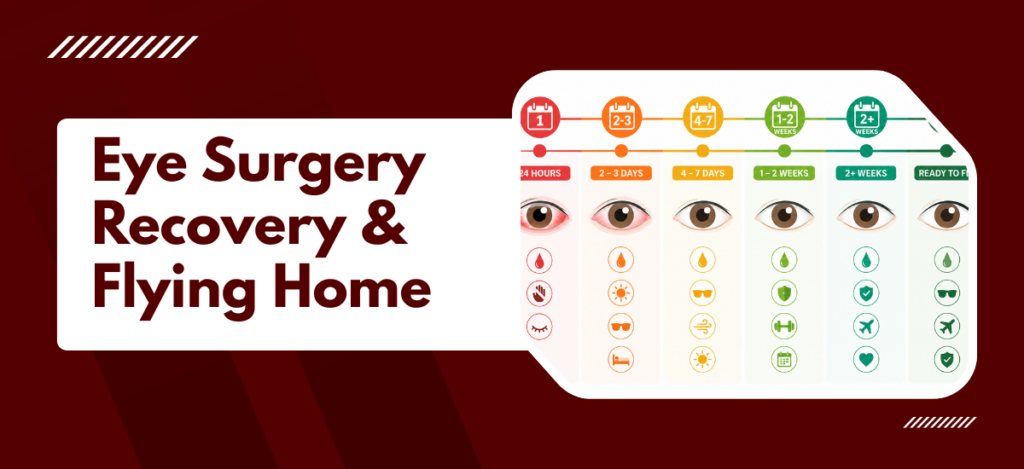
Most international patients receive flight clearance between 5 and 21 days after eye surgery, depending on the procedure performed. Cataract patients are typically cleared between day 3 and day 7 after a post-operative review. Refractive surgery patients receive clearance around day 7. Vitrectomy without intraocular gas requires 7 to 10 days. Retina surgery with a gas bubble carries a no-fly period of 2 to 8 weeks, based on the gas type.
According to Dr. Mayank Bansal, Best Eye Hospital in Delhi, The artificial lens after cataract is unaffected by altitude. A gas bubble inside the eye is the variable that changes the entire recovery plan.
What does the day-by-day recovery look like after eye surgery?
Recovery progresses in defined stages, with most patients regaining functional vision within the first week.
- Day 1: Vision appears foggy, the operated eye remains shielded, and prescribed drops begin the same evening.
- Hours 24-72: Grittiness reduces, outlines sharpen, and light sensitivity persists into the second night.
- Day 4-7: Cataract patients regain reading and walking-level vision, while any stitch-related irritation settles.
- Day 8-14: Refractive cases stabilize and retina cases undergo bubble assessment before any travel clearance.
Recovery is rarely linear and visual acuity can fluctuate between days. Procedure-specific details are covered in this cataract surgery in Delhi page.
When is it actually safe to board a flight after eye surgery?
Flight clearance depends entirely on the procedure performed and whether intraocular gas was used.
- Cataract: Short-haul flights cleared from day 3, long-haul typically from day 5 to 7 after a follow-up scan.
- LASIK or ICL: Day 7 onwards, with lubricating drops carried in hand baggage to manage cabin dryness.
- Vitrectomy without gas: Day 7 to 10, following a confirmatory retinal exam.
- Retina with gas bubble: SF6 gas requires 2 to 3 weeks no-fly; C3F8 gas extends this to 6 to 8 weeks until full absorption.
A final pre-departure assessment is completed before any international flight. Detailed retina protocols are covered in this retina surgery guide.
Why Choose Dr. Mayank Bansal?
Dr. Mayank Bansal holds an MD from AIIMS Delhi, FRCS from the Royal College of Surgeons Glasgow, and Fellowship of the American College of Surgeons, with 15+ years of clinical experience and international fellowships in retinal disease. He has treated patients flying in from the UK, France, Mauritius, USA, and Iraq, and structures every post-operative timeline around the patient’s confirmed return date. Patient credentials and clinical history are documented on the Dr. Mayank Bansal profile page.
International patients depart Delhi with complete surgical reports, follow-up imaging, and a scheduled virtual consultation calendar covering months of remote care. Call +91 8178519983 to book your consultation.
FAQ
Can I fly within 24 hours of cataract surgery?
Most surgeons require 3 to 5 days clearance after a post-operative check.
Is cabin pressure harmful after retinal surgery?
Only if intraocular gas is present, since cabin altitude expands the bubble.
How long should I stay in Delhi after LASIK before flying?
Around 7 days remains the standard recommendation for refractive surgery patients.
Will I need someone to accompany me on the flight?
Complex retina cases benefit from an escort; cataract and refractive patients usually travel independently.
Refrences:
- World Health Organization: Vision and Eye Health
- American Academy of Ophthalmology: Post-Surgery Travel Guidance