 English
 العربية
 Русский
 Français
 Español
 বাংলা
বাংলা Kiswahili
 Deutsch
 中文
中文 日本語
日本語 हिंदी
हिंदी
NHS Cataract Surgery Waiting List vs Private Surgery in Delhi
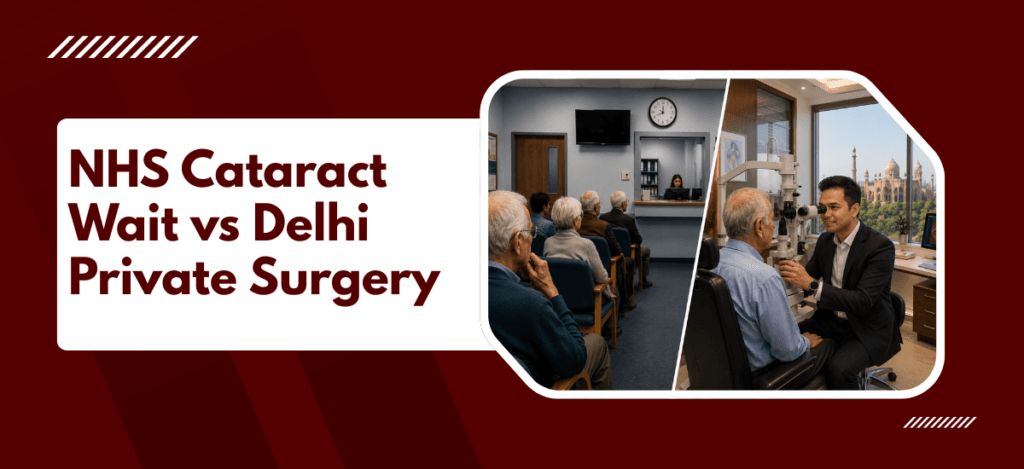
UK patients in 2026 face NHS cataract surgery waits of 26 weeks to over 12 months. Private cataract surgery in Delhi runs 60 to 80 percent cheaper than UK private providers, and access takes days, not months. NHS care stays free at the point of use. Delhi adds faster timelines and broader premium IOL choice.
According to Dr. Mayank Bansal, Best Eye Hospital in Delhi, Vision usually clears within 24 hours of phacoemulsification, and most international patients are back to normal activity by day three if they follow the drop schedule.
How long is the current NHS cataract surgery waiting list?
The 2026 backlog has not eased. Several trusts are still rationing elective slots, and Integrated Care Boards keep tightening eligibility.
- Average wait: Referral to surgery now runs 26 weeks at best. Some ICBs are pushing past 12 months.
- Threshold criteria: Many boards won’t approve surgery until vision drops to 6/12 or worse in the worse eye.
- Second eye delays: The gap between first and second eye surgery often stretches another 3 to 6 months.
- Postcode variation: Where you live matters. A lot. Several trusts are breaching the 18-week constitutional standard outright.
This is why a growing share of UK patients now look at private cataract surgery overseas instead of waiting it out.
How does private cataract surgery in Delhi compare to NHS and UK private options?
The table below sets out the variables UK patients tend to weigh before booking.
Parameter | NHS (2026) | UK Private | Delhi Private |
Wait time | 26 weeks to 12+ months | 2–4 weeks | Within days |
Monofocal IOL cost | Free at point of use | £2,400–£3,200 | £600–£900 |
Premium IOL cost | Not routinely offered | £3,800–£5,500 | £1,100–£1,800 |
Cost saving vs UK private | Not applicable | Baseline | 60–80% lower |
Surgeon continuity | Variable | Single consultant | Same surgeon throughout |
Total stay | Outpatient | Outpatient | 5–7 days incl. travel |
- Surgical technique: Phacoemulsification with a foldable IOL. Same procedure across all three pathways.
- IOL availability: Toric, multifocal, and EDOF lenses from Alcon, Zeiss and Johnson & Johnson sit on the shelf in Indian centres.
- Surgeon credentials: Most Indian consultants doing high-volume cataract work hold international fellowships, often UK or US trained.
- Post-operative follow-up: Discharge reports come formatted for handover to your GP and high street optometrist.
The savings are real, but they only hold up if the outcomes do, which is where the comparison genuinely matters for UK patients. For how the trip itself comes together, see travelling to India for eye surgery.
Why Choose Dr. Mayank Bansal?
Dr. Mayank Bansal is MBBS, MS Ophthalmology, with AIIMS-affiliated anterior segment training. Over 15 years in practice. More than 12,000 cataract procedures done, across both standard phacoemulsification and femtosecond laser-assisted surgery.
International patients get the logistics handled too. Airport pickup, accommodation guidance, scheduling, and a discharge report your NHS GP can actually use.
FAQ
How long is the NHS cataract surgery wait in 2026?
NHS waits now run 26 weeks to over 12 months across most trusts.
How much cheaper is cataract surgery in Delhi vs UK private?
Delhi private cataract surgery costs 60 to 80 percent less than UK private clinics.
Is private cataract surgery in Delhi safe for UK patients?
Yes, accredited centres run international protocols with fellowship-trained surgeons and proper reporting.
How soon can I fly back after cataract surgery in India?
Most patients are cleared for flights 48 to 72 hours after uncomplicated phacoemulsification.