 English
 العربية
 Русский
 Français
 Español
 বাংলা
বাংলা Kiswahili
 Deutsch
 中文
中文 日本語
日本語 हिंदी
हिंदी
Anti-VEGF Injection Brands Compared: Eylea vs Lucentis vs Avastin vs Brolucizumab for Indian Patients
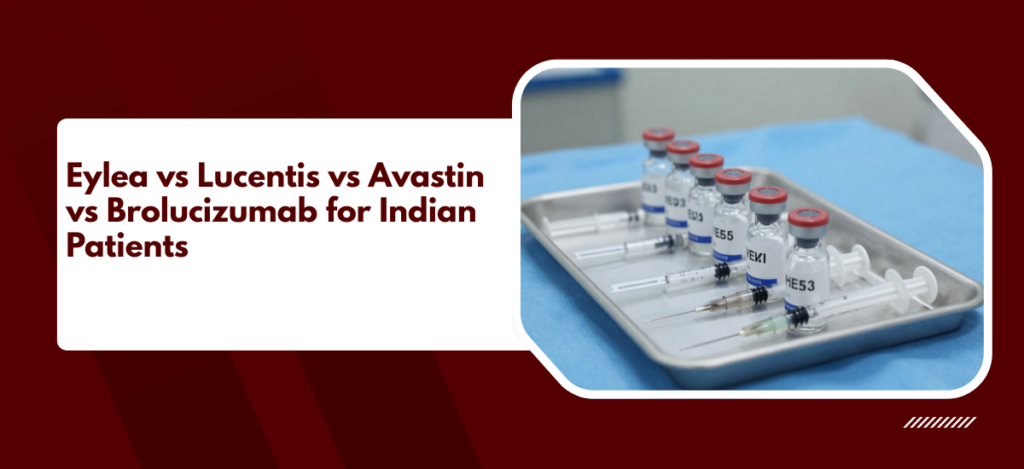
Anti-VEGF injections are the primary treatment for wet age-related macular degeneration, diabetic macular edema, and retinal vein occlusion. Four agents dominate clinical practice in India: Aflibercept (Eylea), Ranibizumab (Lucentis and biosimilars), Bevacizumab (Avastin), and Brolucizumab (Pagenax). Each differs in molecular size, dosing interval, available Indian brands, and cost per injection. The right choice depends on disease activity, treatment history, and the patient’s capacity for follow-up visits.
According to Dr. Mayank Bansal, a leading retina specialist at the Best Eye Hospital in Delhi, “No single anti-VEGF agent is universally superior. We individualise the choice based on OCT fluid activity, the patient’s ability to attend follow-up, and the cost burden over a full treatment course, not just per injection.”
How Do the Four Anti-VEGF Agents Compare?
All four agents block vascular endothelial growth factor to reduce abnormal vessel growth and retinal fluid leakage. The differences lie in molecular structure, binding affinity, dosing frequency, and price.
Parameter | Eylea (Aflibercept) | Lucentis / Razumab (Ranibizumab) | Avastin (Bevacizumab) | Pagenax (Brolucizumab) |
Molecule type | Fusion protein | Monoclonal antibody fragment | Full monoclonal antibody | Single-chain antibody fragment |
VEGF targets | VEGF-A, VEGF-B, PlGF | VEGF-A | VEGF-A | VEGF-A |
Standard dosing interval | Every 8 weeks after loading | Every 4 weeks | Every 4 weeks | Up to 12 weeks |
Indian cost per injection | Rs 20,000–30,000 | Rs 8,000–25,000 | Rs 1,500–3,000 | Rs 30,000–40,000 |
Approved indication | Wet AMD, DME, RVO | Wet AMD, DME, RVO | Off-label (widely used) | Wet AMD |
Key advantage | Fewer injections, broad VEGF coverage | Longest evidence base, biosimilars available | Lowest cost | Longest dosing interval, superior fluid reduction |
The cost figures above reflect Indian market pricing and vary by centre. Annual treatment cost depends heavily on how many injections the treat-and-extend protocol requires for that individual patient. For the full procedure and drug options available at Claritas, Read our blogs on eye injections.
Which Agent Is Used for Which Condition?
Drug selection is not simply brand preference. Disease type, treatment history, and individual OCT response all feed into the decision.
- Wet AMD with high fluid burden: Brolucizumab and Aflibercept both show strong fluid reduction on OCT. Brolucizumab’s higher molar concentration per dose gives it an edge in patients with persistent subretinal or intraretinal fluid after multiple prior injections with earlier agents.
- Diabetic macular edema: Aflibercept holds strong trial data for DME, particularly in patients with baseline vision of 20/50 or worse. Ranibizumab biosimilars like Razumab are cost-effective alternatives for patients requiring frequent injections over several years.
- Retinal vein occlusion: Both Aflibercept and Ranibizumab carry regulatory approval for branch and central RVO in India. Bevacizumab is widely used off-label given the high injection burden in RVO during the first year of treatment.
- Cost-sensitive patients: Bevacizumab remains the most accessible option at Indian public hospitals and tier-2 centres. Its off-label status does not reduce its real-world efficacy, but patients should receive it only from a surgeon who can compound and administer it under sterile conditions.
- Treatment-naive patients with good follow-up: Aflibercept or Ranibizumab are the standard starting choices, with a switch to Brolucizumab considered when OCT-guided treat-and-extend protocols show persistent fluid at 8-week intervals.
Across all four agents, the decision comes down to OCT disease activity and the patient’s ability to attend follow-up. The agent matters less than the monitoring protocol behind it. For a full overview of conditions treated with these agents, the macular degeneration treatment page covers AMD-specific protocols.
Why Choose Claritas Eye Hospital for Eylea ?
Dr. Mayank Bansal is MD (AIIMS), FRCS (Glasgow), FACS, with a retina fellowship at UCLA. Over 15 years of vitreoretinal practice managing wet AMD, DME, and complex retinal vein occlusion with all four major anti-VEGF agents. OCT-guided treat-and-extend protocols are used across all injection patients to minimise total injection burden while protecting vision. International patients receive full support including scheduling, accommodation coordination, and discharge summaries formatted for handover to their ophthalmologist abroad.
FAQ
No single agent is universally best. Aflibercept and Brolucizumab offer longer dosing intervals and strong fluid reduction for wet AMD. Ranibizumab biosimilars such as Razumab provide equivalent outcomes at lower cost. The right choice is determined by OCT activity, patient follow-up capacity, and annual cost burden over the full treatment course.
Costs vary by agent. Bevacizumab runs Rs 1,500 to Rs 3,000 per injection. Ranibizumab biosimilars range from Rs 8,000 to Rs 15,000. Aflibercept (Eylea) costs Rs 20,000 to Rs 30,000 per injection. Brolucizumab (Pagenax) is the most expensive at Rs 30,000 to Rs 40,000, though its longer interval can reduce annual total spend compared to monthly agents.
Bevacizumab is used off-label for retinal conditions and has decades of real-world safety data. It is not formally approved for intravitreal use in India, but is widely administered by vitreoretinal surgeons in cost-sensitive settings. Sterile compounding and experienced injection technique are essential to minimise infection risk.
Loading phase injections are typically given monthly for 3 months across most agents. Maintenance intervals then extend based on OCT response: monthly for Ranibizumab and Bevacizumab, every 8 weeks for Aflibercept, and up to 12 weeks for Brolucizumab in stable patients on a treat-and-extend protocol.
*Disclaimer:* This blog is for educational and informational purposes only and should not be considered professional advice.