 English
 العربية
 Русский
 Français
 Español
 বাংলা
বাংলা Kiswahili
 Deutsch
 中文
中文 日本語
日本語 हिंदी
हिंदी
ICL Surgery for High Myopia Above -10D: Why It Beats LASIK for Severe Glasses Numbers
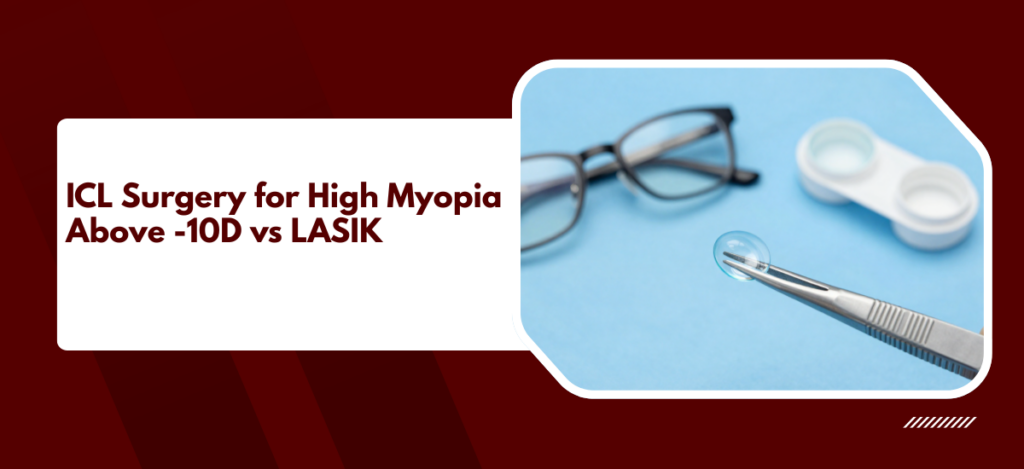
High myopia above -10 dioptres presents a specific challenge for refractive surgery. LASIK works by reshaping the cornea with an excimer laser, but it removes corneal tissue to do so. At high powers the amount of tissue required to achieve the correction exceeds what the cornea can safely spare. An ICL is placed inside the eye between the iris and the natural crystalline lens, correcting the refractive error without touching the cornea at all.
According to Dr. Mayank Bansal, a leading refractive surgeon at the Best Eye Hospital in Delhi,
“For anyone above -8 to -10 dioptres, ICL is not simply an alternative to LASIK it is the safer, more optically superior procedure. The cornea is left entirely untouched, and the correction is reversible if the patient’s prescription changes significantly over time.”
How Does ICL Compare to LASIK for High Myopia?
The two procedures address the same goal through fundamentally different mechanisms. That difference determines which is appropriate for any given patient and prescription.
Parameter | ICL (EVO Visian / Staar) | LASIK / SMILE |
Correction range | Up to -20.0 D | Up to -10.0 D (cornea-dependent) |
Corneal tissue removal | None | Significant at high powers |
Ectasia risk | None | Real risk above -8D in thin corneas |
Reversibility | Fully reversible | Permanent, irreversible |
Optical quality | Superior contrast sensitivity | Good but reduces with power |
Night vision | Excellent | Some degradation at high powers |
Procedure time | 15 to 20 minutes per eye | 10 to 15 minutes per eye |
Dry eye risk | Minimal | Significant (corneal nerve disruption) |
Indian cost per eye | Rs 66,500 to Rs 1,12,500 | Rs 40,900 to Rs 65,500 |
The cost difference narrows considerably when accounting for optical outcome quality at high powers. A -12D patient achieving 6/6 uncorrected vision with excellent contrast sensitivity through an ICL gets a materially better visual result than the same patient managed at the edge of safe LASIK territory. For a full overview of all refractive surgery procedures.
Who Is the Ideal Candidate for ICL at High Myopia?
ICL candidacy is determined by anterior chamber depth, endothelial cell count, and the vault the lens will create between itself and the natural crystalline lens after implantation.
- Prescription range: The Staar EVO Plus ICL platform covers myopia from -0.5 to -20.0 dioptres with cylinder correction up to -6.0 D via the toric variant.
- Anterior chamber depth: A minimum anterior chamber depth of 2.8 mm is required to accommodate the ICL safely.
- Endothelial cell count: ICL implantation requires adequate corneal endothelial cell density, typically above 2,000 cells per mm squared.
- Age: ICL surgery is performed between ages 21 and 45 in most protocols. Below 21, refraction may still be changing.
- Retinal health in high myopes: High myopia carries an intrinsically elevated risk of retinal pathology including lattice degeneration, peripheral breaks, and retinal detachment.
- Post-ICL monitoring: Annual review of vault height, endothelial cell count, and IOP is standard practice for all ICL patients.
The ideal ICL candidate is a high myope with adequate anterior chamber depth, a healthy endothelium, and a prescription stable for at least 12 months who wants spectacle-free vision without the irreversible corneal tissue removal that LASIK requires. For the complete pricing breakdown of ICL options including Staar EVO Plus and toric variants, read our detailed guide on ICL pricing in Delhi.
Why Choose Claritas Eye Hospital for ICL Surgery ?
Dr. Mayank Bansal is MD (AIIMS), FRCS (Glasgow), FACS, with over 15 years of refractive and cataract surgery practice including ICL implantation across the full power range. Pre-operative workup for every ICL patient at Claritas includes anterior chamber depth measurement, endothelial specular microscopy, corneal topography, and dilated retinal examination before any surgical booking is confirmed.
FAQ
LASIK can technically treat up to around -10D in patients with adequate corneal thickness, but at these powers the tissue removal required significantly increases the risk of post-LASIK ectasia. Most experienced refractive surgeons recommend ICL over LASIK for prescriptions above -8D to -10D to avoid this risk.
The ICL is a permanent implant designed to last the patient's lifetime, but it can be removed or exchanged if the prescription changes significantly or if cataract surgery becomes necessary later. This makes it functionally reversible in a way that corneal laser surgery is not.
Yes. The Staar EVO Plus ICL platform is approved and in widespread clinical use for myopia up to -20D. Safety depends on anterior chamber depth, endothelial cell count, and correct lens sizing, not the power of the prescription itself.
Most patients notice significantly improved vision within 24 hours of ICL implantation. Full visual stabilisation occurs within 1 to 2 weeks, and patients can return to normal activities including screen use and light exercise within 48 hours of the procedure.
*Disclaimer:* This blog is for educational and informational purposes only and should not be considered professional advice.