 English
 العربية
 Русский
 Français
 Español
 বাংলা
বাংলা Kiswahili
 Deutsch
 中文
中文 日本語
日本語 हिंदी
हिंदी
Toric IOL for Astigmatism After Cataract Surgery: Candidacy, Cost, and Vision Outcomes
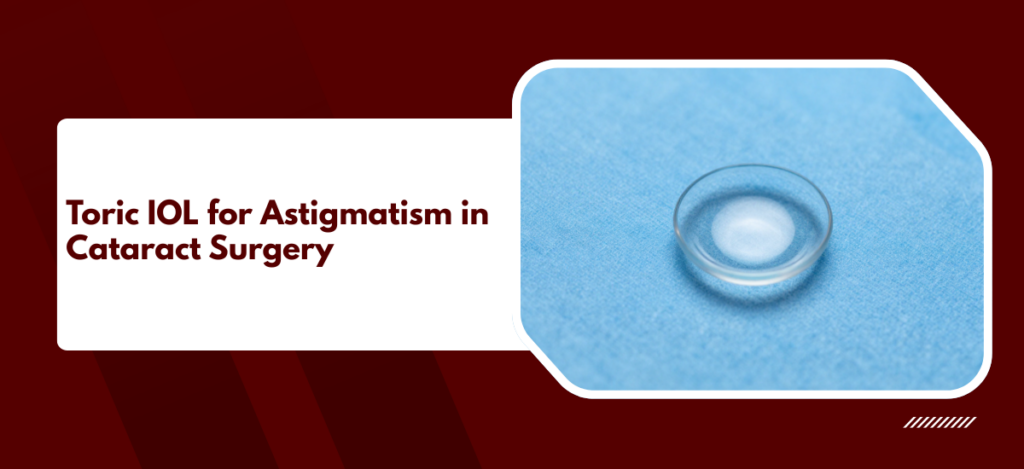
Astigmatism is present in roughly 40 percent of cataract patients at a clinically significant level. A standard monofocal IOL removes the cataract but leaves corneal astigmatism uncorrected, meaning the patient still needs cylindrical glasses for sharp distance vision after surgery. A toric IOL incorporates a cylindrical correction within the lens itself, aligned precisely to the steep corneal meridian during implantation. When selected and positioned correctly, it delivers spectacle-free distance vision in patients who would otherwise remain dependent on glasses despite a successful phacoemulsification.
According to Dr. Mayank Bansal, a leading cataract surgeon at the Best Eye Hospital in Delhi, “A toric IOL is not simply a premium upgrade. It is the clinically correct choice for any cataract patient with 1.0 dioptre or more of regular corneal astigmatism who wants to be free of distance glasses after surgery.”
Who Is a Candidate for a Toric IOL?
Candidacy depends on corneal topography, astigmatism type, and the absence of conditions that make precise IOL alignment unreliable.
Parameter | Suitable for Toric IOL | Not Suitable |
Corneal astigmatism | 1.0 D or more, regular | Irregular (keratoconus, post-LASIK) |
Astigmatism axis | Stable on repeat topography | Fluctuating or inconsistent |
Pupil and zonular status | Normal | Pseudoexfoliation, weak zonules |
Ocular surface | Stable, no active dry eye | Significant dry eye (affects biometry) |
Retinal or optic nerve status | Healthy, good visual potential | Significant macular or optic nerve disease |
Patient expectation | Spectacle freedom at distance | Accepts residual cylinder with glasses |
- Regular vs irregular astigmatism: Toric IOLs correct regular astigmatism, where the cornea curves more steeply in one meridian.
- Dry eye and biometry accuracy: Active dry eye disrupts the tear film, which degrades corneal topography readings and biometry.
- Zonular integrity: The toric lens must stay precisely aligned in the capsular bag after surgery.
- Pre-existing retinal or macular disease: A patient with significant diabetic maculopathy or dry AMD will not achieve the sharp distance vision a toric IOL can theoretically deliver.
- Bilateral astigmatism: When both eyes have significant cylinder, toric IOLs in both eyes eliminate the anisometropia that arises when one eye is corrected and the other is not, producing balanced, spectacle-free binocular distance vision.
The right IOL selection and thorough pre-operative workup determines whether these outcomes are achievable. Read our page on cataract surgery.
What Vision Outcomes and Costs Can Patients Expect?
Clinical outcomes with modern toric IOLs are well established, and the Indian market now offers branded options across different price points.
- Uncorrected distance vision: Published data shows 80 to 90 percent of toric IOL patients achieve 6/12 or better uncorrected distance vision, with the majority reaching 6/6 when biometry and axis alignment are precise.
- Rotational stability: Modern toric IOLs from Alcon, Zeiss, and Johnson and Johnson rotate less than 5 degrees in the capsular bag in the vast majority of cases.
- Toric IOL cost in India: Indian market pricing for toric IOLs ranges from Rs 25,000 to Rs 65,000 per eye depending on the brand and toric power required.
- Toric vs limbal relaxing incisions: Limbal relaxing incisions are an alternative for low degrees of astigmatism below 1.25 D. Above this threshold, a toric IOL delivers more predictable and stable correction, particularly for patients with against-the-rule astigmatism where LRI outcomes are less consistent.
Toric IOL outcomes hold up well over time provided the lens stays within 5 degrees of its intended axis and corneal topography was stable at the time of surgery. Patients who develop significant capsular contraction after implantation may need reassessment of axis alignment at the slit lamp. For a full breakdown of treatment costs across IOL types at Claritas, see IOL pricing in Delhi.
Why Choose Claritas Eye Hospital for Toric IOL?
Dr. Mayank Bansal is MD (AIIMS), FRCS (Glasgow), FACS, with over 15 years of cataract and anterior segment practice including more than 12,000 cataract procedures. Toric IOL planning at Claritas uses corneal topography, swept-source biometry, and online toric calculators from Alcon and Zeiss to determine axis alignment to the nearest degree before surgery. International patients receive complete pre-operative workup, IOL selection guidance, and discharge summaries structured for handover to their treating ophthalmologist at home.
FAQ
A toric IOL is an intraocular lens with a built-in cylindrical correction aligned to the steep corneal meridian during cataract surgery. It corrects both the cataract and the pre-existing corneal astigmatism in a single procedure, reducing or eliminating the need for distance glasses after surgery.
Toric IOL pricing in India ranges from Rs 25,000 to Rs 65,000 per eye depending on the brand and the degree of cylinder correction required. The additional cost over a standard monofocal IOL reflects the precision manufacturing and the pre-operative topography planning involved.
Yes. If post-operative rotation reduces the astigmatic correction, the lens can be repositioned under topical anaesthesia within the first few weeks while the capsular bag is still mobile. Beyond this window, repositioning becomes technically more demanding.
No. Toric IOLs only correct regular corneal astigmatism. Patients with keratoconus, corneal scarring, or post-refractive surgery irregular astigmatism require a different management approach and are not suitable candidates for toric IOL implantation.
*Disclaimer:* This blog is for educational and informational purposes only and should not be considered professional advice.