
 English
 العربية
 Русский
 Français
 Español
 বাংলা
বাংলা Kiswahili
 Deutsch
 中文
中文 日本語
日本語 हिंदी
हिंदी
What is Polypoidal Choroidal Vasculopathy (PCV)?
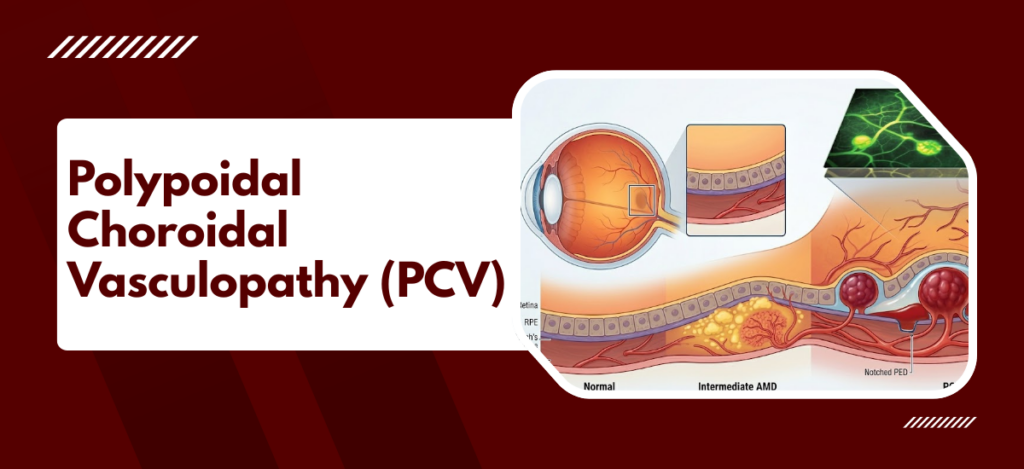
Polypoidal Choroidal Vasculopathy (PCV) is a vascular disease of the choroid that causes sudden, severe vision loss from leaking, aneurysm-like polyps under the retina. Doctors used to file it as a subtype of wet age-related macular degeneration (AMD). Turns out it isn’t. In Asian populations it drives 25 to 50 percent of all neovascular AMD cases, which makes it a leading cause of central blindness across the region. Most patients are men, mostly between 50 and 65. The vessels involved sit deeper than in regular wet AMD, and the bleeds they produce can be massive. Anti-VEGF shots alone? Often not enough.
According to Dr. Mayank Bansal, Best Eye Hospital in Delhi, PCV needs ICGA confirmation before treatment because what looks like ordinary wet AMD on OCT often turns out to be a polypoidal lesion that won’t respond to injections alone.
How Is PCV Different From Standard Wet AMD?
Both diseases damage the macula. The mechanism behind them isn’t even close to the same.
Vessel origin: PCV grows from the inner choroidal layer with branching trunks ending in polyp-shaped balloons, while wet AMD starts higher up, beneath the retinal pigment epithelium, as classic neovascular tissue.
Bleeding behavior: huge subretinal hemorrhages, the kind that drop central vision overnight, hit PCV patients far more often than typical AMD patients and they don’t always announce themselves first.
Imaging: OCT alone misses the polyps in a worrying number of cases. ICGA catches them. That single test changes the diagnosis.
Drug response is the part that frustrates patients: Some PCV polyps shrink with injections. Others barely budge, and those usually need photodynamic therapy added to the protocol for the vessels to actually close.
Get the diagnosis wrong, and the wrong treatment quietly burns through months of vision.
Plenty of patients labelled “anti-VEGF resistant wet AMD” elsewhere walk into a proper Retina Surgery workup and leave with a PCV diagnosis instead.
Who Should Get Screened for Polypoidal Choroidal Vasculopathy?
PCV doesn’t follow the demographic pattern Western textbooks teach for AMD.
Asian patients top the risk list by a wide margin: South Asian, East Asian, and Southeast Asian populations show PCV rates anywhere from 22 to 55 percent of their wet AMD caseload, depending on the study.
Men past 50: That’s the typical face of this disease, which flips the usual AMD ratio where women dominate.
Anyone hit by sudden central vision change: A new dark spot, wavy lines on a doorframe, a fat floater that wasn’t there yesterday, these aren’t symptoms to sit on, and timely anti-VEGF eye injections often save what’s left of the macula.
High blood pressure and smoking each push PCV risk up independently: Stack them on a family history of retinal disease and the timeline shortens considerably.
So yeah. If even one box gets ticked, ICGA screening earns its place.
Combined OCT and ICGA imaging done by a retinal specialist nails the diagnosis and points to the right treatment from day one. For more on related retinal conditions, see macular hole symptoms and surgery or this retinal disease surgery guide.
Why Choose Dr. Mayank Bansal?
Dr. Mayank Bansal trained at AIIMS and went on to earn FRCS Glasgow, FAICO, and an ICO retina fellowship at UCLA, with more than 15 years now spent treating complex retinal cases. That mix of Indian and international training shapes how every PCV case is worked up here, and Dr. Mayank Bansal personally handles the diagnostic call on tricky presentations.
Patients who came in carrying a wet AMD label, only to be reclassified as PCV after proper imaging, have walked out with usable central vision restored at Claritas Eye & Retina Institute. Right diagnosis first. Treatment works after that.
FAQ
Is PCV the same as wet AMD?
No, PCV is a distinct subtype of wet AMD with different vessel structure.
Which test confirms polypoidal choroidal vasculopathy?
Indocyanine green angiography (ICGA) is the gold-standard diagnostic test.
Does PCV respond to standard anti-VEGF injections?
Response varies, and many patients require combination therapy for adequate control.
Can PCV cause permanent vision loss?
Yes, untreated PCV bleeds can cause irreversible central vision damage quickly.